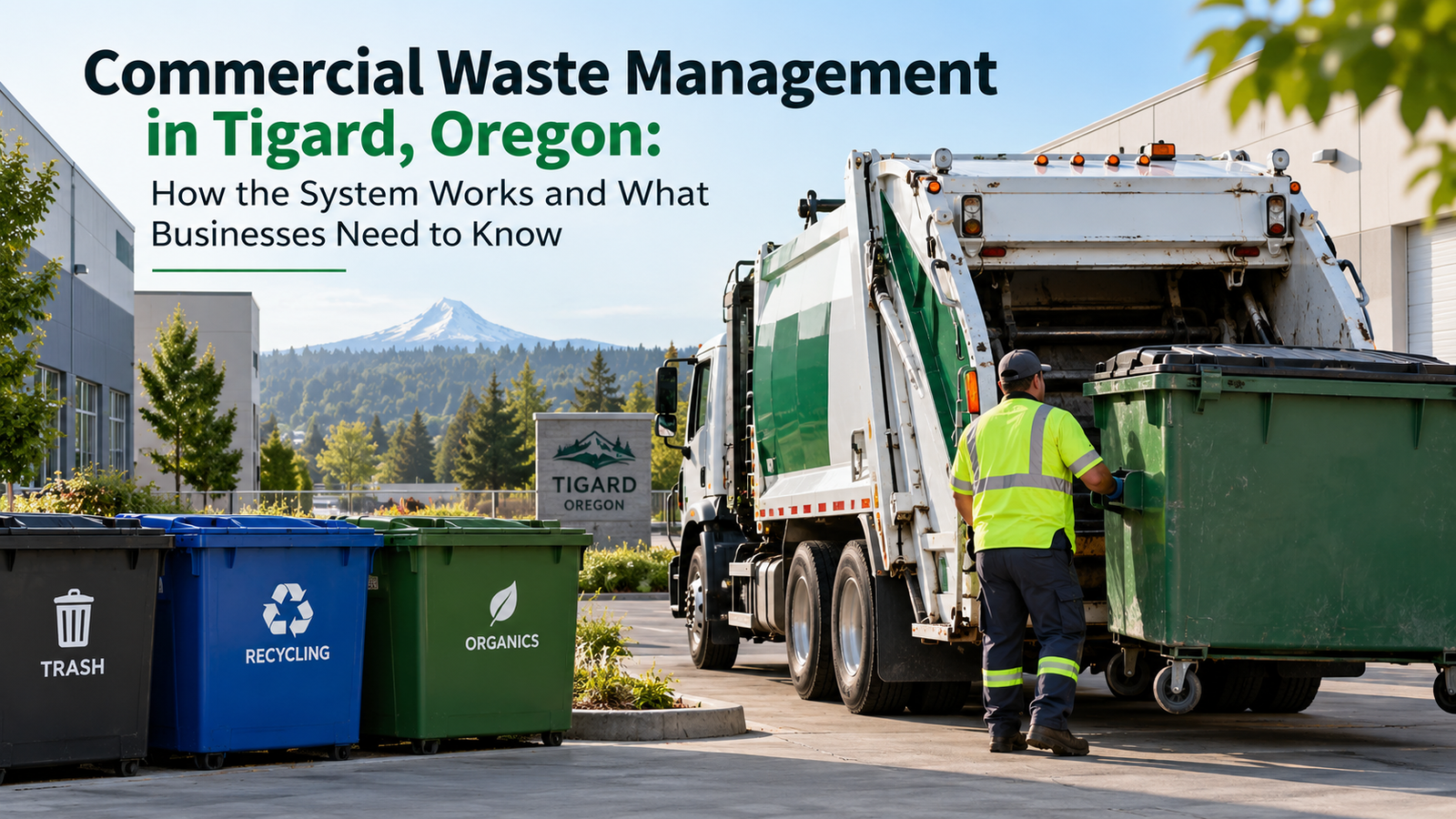
Tigard’s commercial landscape is diverse a city of roughly 55,000 residents that includes the Washington Square regional mall and its surrounding retail corridor, the business and light industrial districts along 72nd Avenue and Bonita Road, a growing density of professional services and healthcare providers, restaurant and food service operations, and the expanding mixed-use commercial development near the Tigard Transit Center. Each of these business types generates different categories and volumes of waste, and managing that waste responsibly in Tigard means navigating a system that extends from franchise hauler service through Washington County’s Business Recycling Requirements, Oregon Metro’s regional oversight, and the private supplemental services that address waste categories that the standard franchise system is not designed to handle. This guide explains how Commercial Waste Management Tigard works in Tigard and what businesses operating in the city need to understand about their obligations and options.
Tigard’s Commercial Franchise Hauler System
The foundation of commercial waste collection in Tigard is the franchise hauler system established under Tigard Municipal Code Chapter 11.04. The City of Tigard grants exclusive rights to collect solid waste within defined service areas to two haulers: Pride Disposal Company, which services Areas 1 and 3 of the city, and Waste Management, which services Area 2. A business’s assigned hauler is determined by the geographic service zone of its address businesses do not select their hauler. This franchise structure ensures consistent service standards and regulated rates throughout the city, regardless of which specific company serves a given location.
Commercial garbage service from the franchise haulers covers the standard solid waste generated by Tigard businesses the non-recyclable, non-hazardous material that represents the residual waste stream after recyclables, organics, and regulated materials have been diverted to appropriate channels. Commercial containers range from small 32-gallon carts appropriate for low-volume generators to large front-load dumpsters of 1 to 8 cubic yards serviced multiple times per week for high-volume commercial generators. The frequency and container size for any given Tigard business is determined by that business’s waste generation volume and the service schedule that the hauler provides.
Commercial recycling is bundled with commercial garbage service in Tigard under the framework established by Tigard Municipal Code 11.04 and the Oregon Recycling Opportunity Act. Tigard’s franchise haulers are required to provide recycling opportunity to all commercial customers meaning that Tigard businesses must have access to recycling service as part of their waste management program, not as an optional add-on. This recycling opportunity obligation reflects Oregon’s longstanding commitment to material diversion from landfill, which has consistently led the nation in recycling program development and innovation since the early 1990s.
Washington County’s Business Recycling Requirements
Beyond the franchise hauler’s service obligation, Tigard businesses are subject to Washington County’s Business Recycling Requirements (BRR) a set of mandatory recycling practices that apply to all businesses in Washington County communities including Tigard. The BRR requires that Tigard businesses recycle paper, cardboard, and containers (aluminum cans, plastic bottles and tubs, and glass bottles and jars). Businesses must provide internal recycling receptacles throughout the workplace, post signage at collection areas indicating which materials must be recycled, and ensure that employees have access to recycling bins in common areas.
Washington County’s Solid Waste and Recycling program provides Green Business Advisors who offer free technical assistance to businesses in Tigard, Tualatin, Hillsboro, Beaverton, and other Washington County communities. These advisors help businesses set up compliant recycling systems, provide free signage, bins, and educational materials, and identify opportunities to increase the recycling rate and reduce waste generation costs. The free advisory service is particularly valuable for smaller Tigard businesses that may not have dedicated sustainability staff to manage waste program compliance.
Compliance with the Business Recycling Requirements is linked to Washington County business licensing. When a business signs its license or annual renewal, it agrees to comply with the applicable BRR provisions. Non-compliant businesses may be subject to enforcement action through the county and city licensing process. Washington County’s Solid Waste and Recycling program website at washingtoncountyor.gov/swr provides specific guidance on BRR requirements and the compliance verification process.
Oregon Metro’s Regional Framework and Commercial Waste in Tigard
Oregon Metro the elected regional government for the greater Portland metropolitan area encompassing Washington, Multnomah, and Clackamas Counties provides the regional infrastructure, planning, and oversight within which Tigard’s commercial waste management operates. Metro’s responsibilities include operating regional waste management facilities (the Metro South Transfer Station in Tualatin serves the Washington County area including Tigard), establishing regional waste reduction goals, overseeing the franchise hauler authorization system, and managing the regional household hazardous waste program.
For Tigard businesses, Oregon Metro’s most practical relevance is through its transfer station network. Businesses that need to self-haul waste either because they generate material in volumes or categories that exceed their franchise service, or because they are handling post-renovation, post-construction, or other irregular waste streams can bring material directly to Metro South Transfer Station at 2001 Washington Street in Tualatin. Metro’s facilities accept a wide range of commercial waste streams, with specific rules for special wastes (materials requiring additional handling), asbestos-containing materials (not accepted at Metro transfer stations and requiring permitted disposal elsewhere), and hazardous materials.
Metro’s Business Waste Hotline at (503) 234-3000 connects Tigard businesses to information about disposal options for specific material types, including electronics, fluorescent lights, batteries, used oil, and other specialty streams that require specific handling under Oregon DEQ and EPA regulations. This hotline is a practical resource for businesses managing waste categories outside their standard franchise service.
Food Waste and Organics Management for Tigard Businesses
Food service businesses in Tigard restaurants, cafes, catering operations, grocery stores, food manufacturers, and institutional food service operations are subject to Oregon’s commercial food waste requirements. Oregon requires that food businesses generating 250 pounds or more of food waste per week separate food scraps for collection. Washington County’s food scrap recovery program provides the infrastructure for this requirement, with commercial organics collection available through Tigard’s franchise haulers for businesses that need it.
The food scraps collected from Tigard businesses are transported to composting facilities that process them into compost used in Washington County agriculture and landscaping. This composting pathway diverts food waste that would otherwise generate methane in landfills methane is a potent greenhouse gas, and diverting organic material from landfill is one of the most impactful individual waste actions that businesses can take for climate benefit.
Tigard’s restaurant and food service sector, particularly the clusters of food-oriented businesses along Hwy 99W, Pacific Highway, and near Washington Square, represents a significant aggregate food waste generator. Washington County’s Solid Waste and Recycling program and the franchise haulers work with these businesses to right-size their organics collection service, provide appropriate containers, and minimize the barriers to participation in the food scrap diversion program.
Commercial Construction and Demolition Waste in Tigard
Construction and demolition (C&D) debris is a category of commercial waste that requires different management than standard franchise service. C&D debris from Tigard commercial construction, renovation, tenant improvement, and demolition projects is not handled through the standard curbside commercial collection it requires specific containers (roll-off dumpsters or direct haul to transfer stations), and Oregon Metro’s guidance establishes that all construction waste from the greater Portland area must follow specific disposal processes.
Oregon Metro tracks and reports C&D debris generation and diversion rates as part of its regional solid waste planning responsibilities. The region has established material recovery goals for C&D debris that encourage source separation separating concrete, metal, wood, drywall, and other materials at the job site rather than mixing them in a single container. Source-separated C&D materials access better recycling economics: concrete goes to RCA processors, metal to scrap recyclers, clean wood to biomass or wood recyclers, and clean drywall (gypsum) to gypsum recycling operations where available.
For Tigard commercial property owners and managers undertaking renovation projects office remodels, restaurant buildouts, retail refreshes, or tenant improvement demolitions working with a debris removal service that actively sorts and recycles C&D material reduces disposal costs relative to mixed-load disposal, supports compliance with Washington County’s waste diversion expectations, and aligns with the sustainability practices that many Tigard commercial tenants and customers expect from the properties they occupy.
Specialty Waste Streams for Tigard Businesses
Several categories of commercial waste require specific handling that falls outside the standard franchise hauler service. Tigard businesses that generate these materials need to understand their obligations and the specific disposal channels that apply.
Electronics and e-waste generated by Tigard businesses including computers, monitors, printers, phones, servers, and other electronic devices must be recycled through Oregon’s E-Cycles program. Oregon law prohibits disposing of covered electronics in garbage service, and the E-Cycles program provides free drop-off recycling for covered devices at participating locations throughout Washington County. Businesses replacing large quantities of electronics may need to coordinate pickup service, which E-Cycles facilitates for commercial generators through its website at ecyclesolutions.com.
Universal waste including fluorescent lamps, batteries, mercury-containing devices, and certain pesticides is subject to Oregon DEQ’s Universal Waste Rule, which allows businesses to accumulate these materials for up to one year before disposal and requires that they be sent to licensed universal waste handlers rather than landfill disposal. Washington County’s Solid Waste and Recycling program maintains a directory of permitted universal waste handlers serving Tigard businesses.
Hazardous waste generated by Tigard businesses including paints, solvents, cleaning chemicals, petroleum products, and other materials regulated under Oregon’s hazardous waste program (OAR 340, Division 100) requires management under a specific regulatory framework that includes generator classification, storage standards, and permitted disposal through licensed hazardous waste transporters and facilities. Oregon DEQ’s Hazardous Waste program provides guidance for businesses at all generator size levels, from very small quantity generators (VSSQGs) up through large quantity generators with full regulatory compliance obligations.
Private Supplemental Commercial Waste Services in Tigard
The franchise hauler system and the regulatory framework described above address the standard, ongoing waste generation of Tigard businesses. But commercial properties regularly generate waste situations that fall outside the standard system situations where private supplemental services provide the most practical solution.
Commercial cleanouts and property management transitions clearing the contents of a vacated commercial space, removing outdated fixtures and equipment from a retail location, or managing the debris from a tenant improvement project involve both the volume and the material diversity that private junk removal and debris services are designed to handle. These services come to the commercial property, remove specified material from wherever it is located, sort it for recycling and donation, and transport it to appropriate facilities providing the on-demand, full-service capability that the scheduled franchise hauler system is not designed to offer.
Roll-off dumpster rental for commercial renovation and construction projects provides the temporary, large-volume container capacity that supplement the standard franchise service during periods of elevated waste generation. Tigard commercial properties undergoing renovation need access to temporary containers that can be swapped out as they fill throughout the project, rather than relying on the weekly or twice-weekly commercial collection schedule that works for normal operations but cannot accommodate renovation-scale waste generation.
Emergency cleanup and debris removal services address the irregular, urgent situations that commercial properties encounter storm damage, water damage from pipe failures, fire damage debris clearance, and similar events that create immediate cleanup needs outside any scheduled service framework. Tigard’s location in the Pacific Northwest, with its wet winters and occasional wind events, creates genuine demand for emergency debris removal services that private contractors provide when franchise service schedules cannot accommodate urgent needs.
Common Questions About Commercial Waste Management in Tigard
Which franchise hauler serves my Tigard business? Your assigned hauler either Pride Disposal or Waste Management is determined by your address’s location within Tigard’s franchise service zones. The City of Tigard’s Solid Waste and Recycling page and Oregon Metro’s garbage and recycling day tool at oregonmetro.gov can identify your assigned hauler. Businesses can also contact the City of Tigard at the public works department to confirm their hauler assignment.
Are Tigard businesses required to recycle? Yes. Washington County’s Business Recycling Requirements mandate that businesses recycle paper, cardboard, and containers. The franchise hauler’s required recycling service provides the collection infrastructure, and businesses must implement internal systems to separate these materials for collection. Washington County’s Green Business Advisors provide free assistance to help businesses set up compliant systems.
What should a Tigard business do with large quantities of electronics or fluorescent lights that need disposal? Oregon’s E-Cycles program handles covered electronic devices. Universal waste handlers accept fluorescent lights, batteries, and other universal waste from commercial generators. Washington County’s Solid Waste and Recycling program at washingtoncountyor.gov/swr provides a directory of accepted disposal channels for specific material types, and Metro’s Business Waste Hotline at (503) 234-3000 can direct businesses to appropriate resources.